
If you work in recruitment marketing, one of the most common questions you will hear from clients or internal stakeholders is:
“How do we actually measure SEO ROI?”
It is also one of the hardest questions to answer properly because SEO performance is often reported using metrics that look impressive on paper but do not necessarily connect back to commercial outcomes.
In recruitment specifically, ROI should not just be measured through increases in traffic or impressions. It should be measured through improvements in:
- Qualified candidate applications
- Client enquiries
- Job visibility
- Candidate engagement
- Brand authority within specialist markets
- Long-term search visibility for commercially valuable searches
A recruitment website ranking for thousands of irrelevant keywords does not generate meaningful ROI if the traffic is unqualified or fails to convert.
The recruitment businesses seeing the strongest long-term SEO performance are usually the ones focusing less on vanity metrics and more on the indicators that directly influence placements, lead generation, and revenue growth.
Below are five of the most important areas we look at when measuring SEO ROI properly within recruitment marketing.
1. Focus on Top 10 Rankings Instead of Total Keyword Count
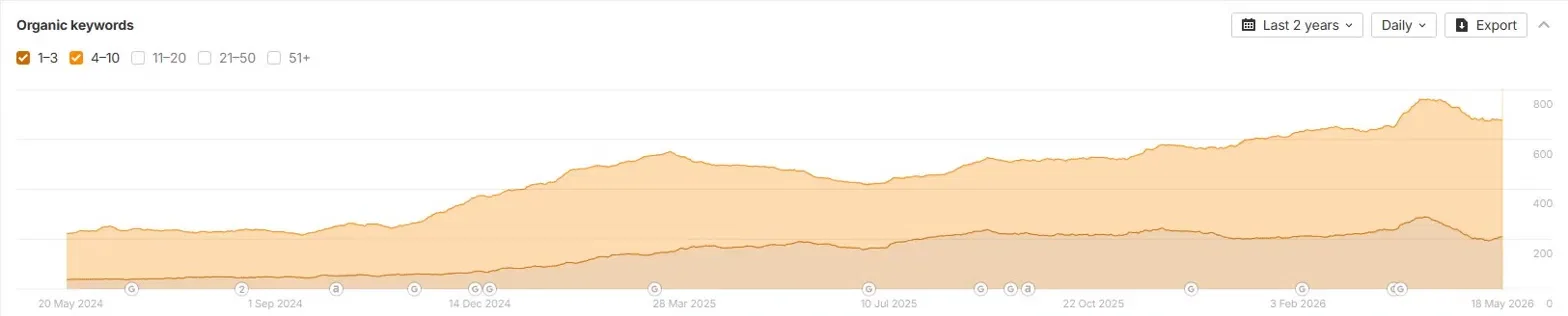
One of the biggest misconceptions we still see in recruitment SEO reporting is businesses placing too much importance on overall keyword count.
Historically, SEO platforms like Ahrefs and SEMrush gave marketers a relatively reliable estimate of how many keywords a website ranked for and how visibility was changing over time. However, over the last 18 months, the accuracy of third-party keyword tracking data has become far less consistent.
A major reason for this was Google’s March 2024 core update, which significantly changed how Google:
- Groups keywords
- Understands user intent
- Evaluates content quality
- Filters low-value or scaled AI-generated content
Because Google’s ranking systems changed so heavily, many third-party SEO tools struggled to adapt their own modelling systems quickly enough.
Tools like Ahrefs and SEMrush do not have direct access to Google’s internal search data. Instead, they rely on:
- Large-scale crawling systems
- Predictive ranking models
- Historical click-through behaviour
- Estimated search demand patterns
When Google fundamentally changes how rankings behave, those estimation models naturally become less accurate.
That does not mean these tools are no longer useful. They still provide huge value for:
- Visibility tracking
- Competitor analysis
- Technical SEO auditing
- Identifying search trends
- Monitoring keyword movement
However, the gap between what third-party platforms estimate and what is actually happening within live Google search results has widened significantly.
That gap became even larger in September 2025 when Google removed the “&n=100” parameter, which historically allowed third-party SEO software to pull the top 100 search results directly from Google.
This was a major shift for the SEO industry because many ranking systems relied on this parameter to collect large-scale ranking data. Once removed, tracking providers lost a large amount of visibility into broader ranking positions, making long-tail keyword monitoring and large-scale rank tracking much harder.
As a result, total keyword count has become a far weaker KPI than it once was.
From an ROI perspective, what matters far more now is:
- Rankings within positions 1–3
- Keywords consistently appearing in positions 4–10
- Visibility for commercially valuable recruitment searches
- Month-on-month ranking improvements
- Search intent behind ranking terms
These are the positions that actually generate:
- Qualified traffic
- Candidate applications
- Client enquiries
- Conversion opportunities
For example, ranking in the top three for:
“construction recruitment agency London”
is likely to generate significantly more commercial value than ranking position 45 for a broad informational keyword with minimal intent.
For recruitment businesses, SEO ROI should be measured through visibility for commercially relevant searches rather than overall keyword volume.
From a search optimisation perspective, this is also where topical authority becomes increasingly important for both Google Search and AI-generated search experiences.
Creating highly relevant, specialist recruitment content around:
- Industry sectors
- Candidate intent
- Salary insights
- Hiring trends
- Location-specific recruitment
- Client pain points
helps strengthen search relevance and improves the likelihood of appearing within:
- Traditional search results
- AI-generated search summaries
- Google AI Overviews
- Conversational search experiences
The more contextually relevant and commercially aligned the content is, the stronger the long-term SEO return tends to become.
2. Measure Which Landing Pages Actually Generate Commercial Value
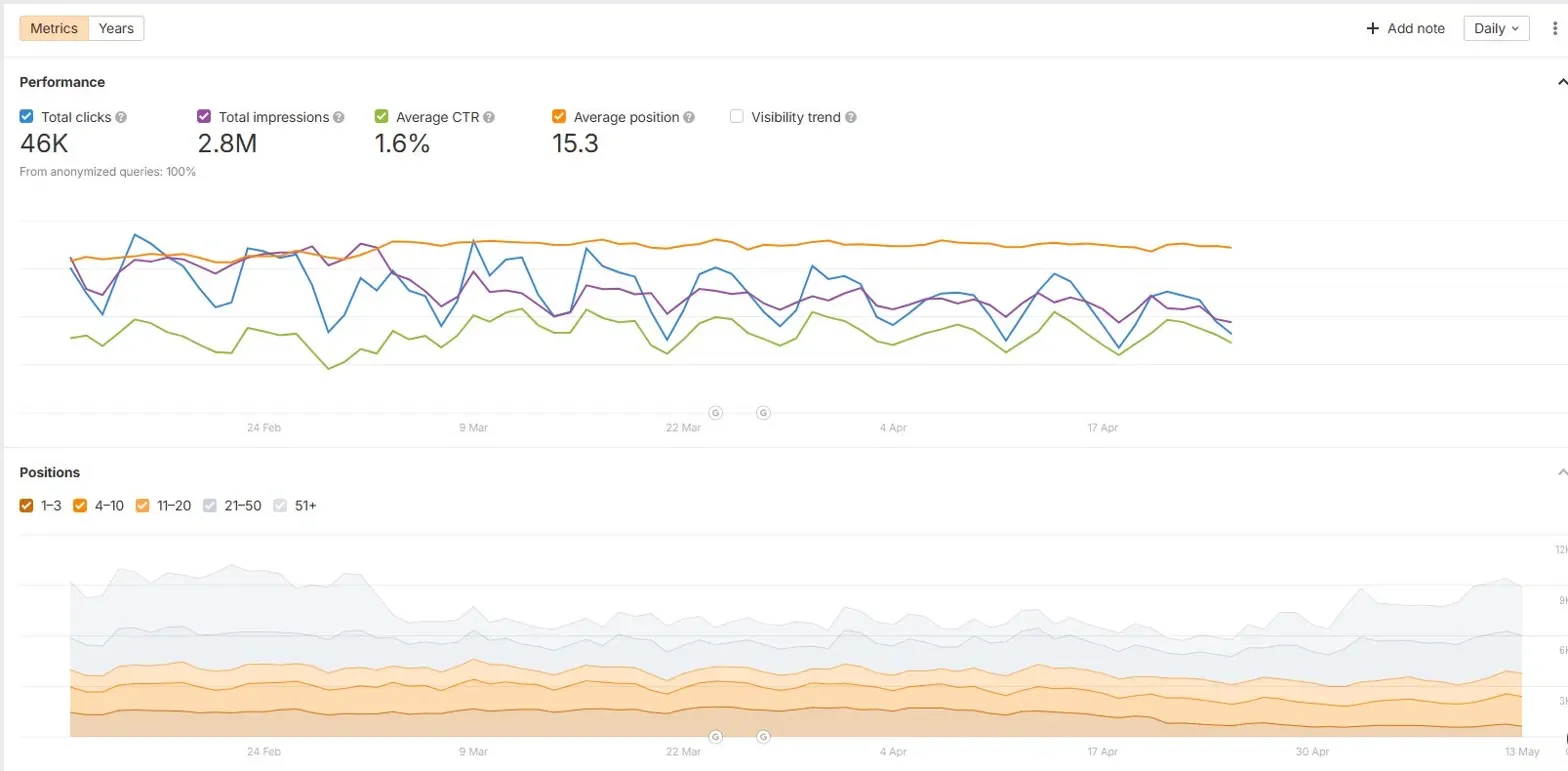
Traffic alone is not a reliable indicator of SEO ROI. One of the most important things recruitment businesses should analyse is which landing pages are actually contributing towards commercial outcomes. In many cases, the pages generating the highest traffic are not necessarily the pages driving the strongest engagement or conversions.
We regularly see examples where:
- Homepages generate high traffic but poor engagement
- Sector pages drive stronger candidate quality
- Location-specific recruitment pages convert more effectively
- Specialist job vertical pages produce higher enquiry rates
This is why analysing landing page performance through Google Search Console and GA4 is so important.
Key metrics should include:
- Organic traffic by landing page
- Application conversion rate
- Bounce rate
- Time on page
- Scroll depth
- Candidate engagement signals
- Client enquiry conversions
From an ROI perspective, this helps recruitment businesses identify:
- Which pages contribute towards placements
- Which content drives candidate intent
- Which service pages support lead generation
- Which pages need UX or content optimisation
This also creates stronger opportunities for AI optimisation.
AI-driven search experiences increasingly favour pages with:
- Clear topical relevance
- Strong engagement signals
- Helpful structured content
- High contextual depth
- Direct answers to user intent
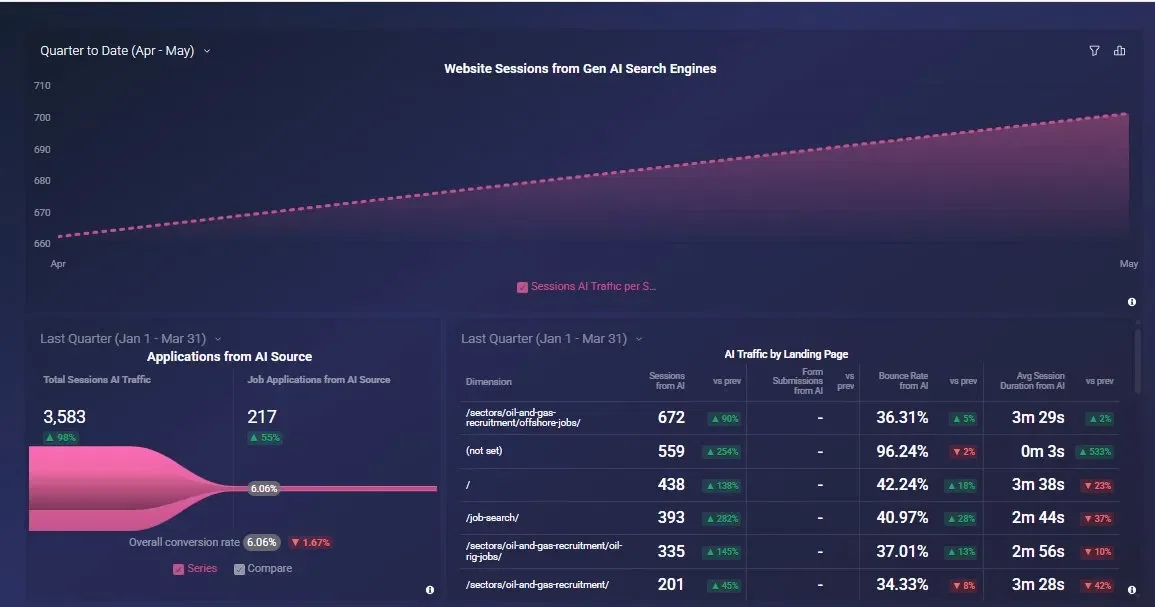
The more useful and commercially relevant a landing page becomes, the stronger its long-term visibility tends to be across both traditional and AI-enhanced search environments.
3. Segment Keywords by Search Intent
Not all traffic carries the same commercial value.
One of the biggest reporting mistakes we still see is recruitment businesses grouping all keywords together without analysing intent properly.
For example:
- “What does a finance analyst do?” is informational
- “Finance analyst jobs Manchester” is transactional
- “Finance recruitment agency Manchester” is highly commercial
Although all three searches may generate traffic, the likelihood of conversion is completely different.
Segmenting keywords by intent helps recruitment businesses understand:
- Which searches generate applications
- Which keywords contribute towards lead generation
- Which content supports brand awareness
- Which pages attract high-intent candidates
- Which topics generate stronger engagement over time
The main intent categories we typically analyse include:
- Transactional searches
- Informational searches
- Brand searches
- Local intent searches
- Industry-specific searches
- Event and community-driven searches
This gives a much clearer understanding of where SEO investment is generating the strongest ROI.
We are also seeing this become increasingly important when analysing event-based content, resource hubs, and industry-focused campaigns.
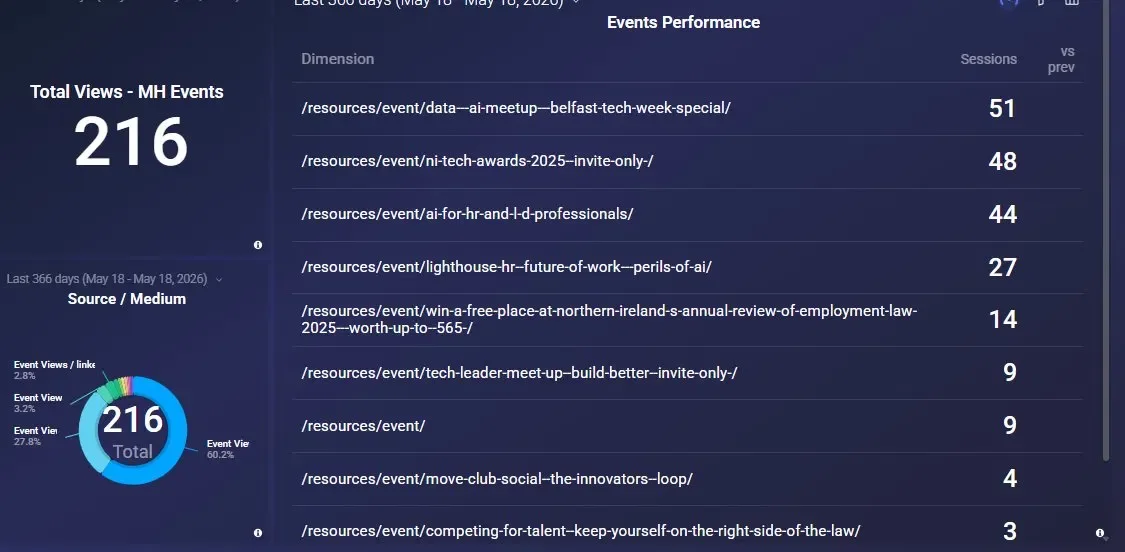
For example, searches around:
- AI recruitment events
- HR technology meetups
- Employment law events
- Recruitment networking sessions
- Industry webinars and roundtables
often attract highly engaged users because the search intent is much more specific.
The screenshot below shows how event-focused landing pages can be monitored to understand:
- Which topics are driving the strongest engagement
- Which event pages attract the highest session volumes
- Which industries are generating the most interest
- How users are interacting with specialist content
This type of reporting gives far more context around content ROI than simply measuring traffic volumes alone.
It also helps improve AI search optimisation because intent alignment is becoming increasingly important within:
- Google AI Overviews
- Conversational search
- Generative AI search engines
- AI-powered recommendation systems
Content that directly answers clear user intent is far more likely to be surfaced within AI-generated responses.
4. Monitor Website Health as a Leading Indicator
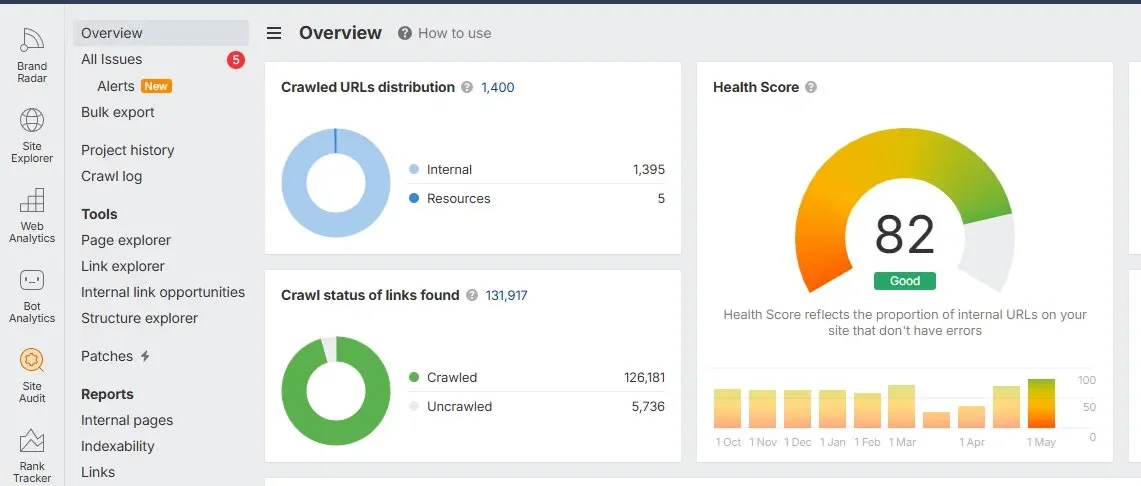
Technical SEO issues often impact ROI long before businesses realise there is a problem.
For recruitment websites specifically, technical SEO can become particularly challenging because:
- Job pages constantly change
- Expired roles accumulate quickly
- Location pages continue expanding
- Internal linking structures become more complex over time
Monitoring website health helps identify problems before rankings and conversions begin declining.
The areas we usually monitor most closely include:
- Crawlability
- Indexation
- Internal linking
- Broken pages
- Redirect chains
- Site speed
- Mobile usability
- Structured data implementation
A decline in technical health often results in:
- Reduced crawl efficiency
- Lower search visibility
- Poorer indexing
- Reduced page authority distribution
- Lower conversion performance
From an ROI perspective, technical SEO directly impacts how efficiently recruitment websites can:
- Rank new pages
- Maintain existing rankings
- Distribute authority internally
- Improve candidate experience
- Support conversion journeys
Strong technical foundations are also becoming increasingly important for AI search visibility, particularly around:
- Structured content
- Entity understanding
- Internal context
- Semantic relevance
- Crawl accessibility
The easier a website is for search engines and AI systems to interpret, the stronger the long-term visibility potential becomes.
5. Track Keyword Movement and Visibility Trends
Static ranking reports rarely tell the full story. One of the clearest indicators of improving SEO ROI is consistent ranking movement over time.
Monitoring visibility trends helps identify:
- Which optimisations are working
- Which pages are improving
- Which sectors are gaining traction
- Where new opportunities exist
- Which areas need intervention early
At Venn, we regularly track:
- Keywords entering the top 10
- Keywords gaining 5+ positions
- New visibility trends
- Top 10 losses
- Landing pages showing upward movement
- Search share within key recruitment sectors
This helps create a much clearer commercial narrative around SEO performance rather than simply reporting isolated ranking numbers.
From an ROI perspective, improving search visibility usually leads to:
- Increased qualified traffic
- Higher application rates
- Better candidate engagement
- More inbound enquiries
- Greater brand authority
It also supports stronger optimisation for AI-driven search because consistent authority growth within a specialist topic area helps improve:
- Entity recognition
- Topical authority
- Search trust signals
- Semantic relevance
The more consistently a recruitment business builds authority within its specialist markets, the stronger its long-term organic visibility becomes across both search engines and AI search experiences.
Final Thoughts
SEO ROI within recruitment should never be measured purely through traffic increases or keyword totals.
The businesses generating the strongest long-term results are usually the ones focusing on:
- Commercial search intent
- Candidate quality
- Landing page performance
- Technical SEO health
- Topical authority
- Visibility within commercially valuable searches
As search continues evolving towards AI-generated experiences and conversational search behaviour, recruitment businesses also need to think beyond traditional rankings alone.
Creating genuinely useful, commercially relevant, specialist content is becoming increasingly important for:
- Google rankings
- AI-generated search visibility
- Brand authority
- Candidate trust
- Long-term lead generation
Ultimately, the strongest SEO ROI comes from improving visibility for the searches that actually contribute towards business growth.