
Most careers and recruitment sites already have the core components in place. Job listings, company information, benefits, and sometimes a careers video. Structurally, they do what they’re supposed to do.
What’s changing is how candidates find and engage with that content.
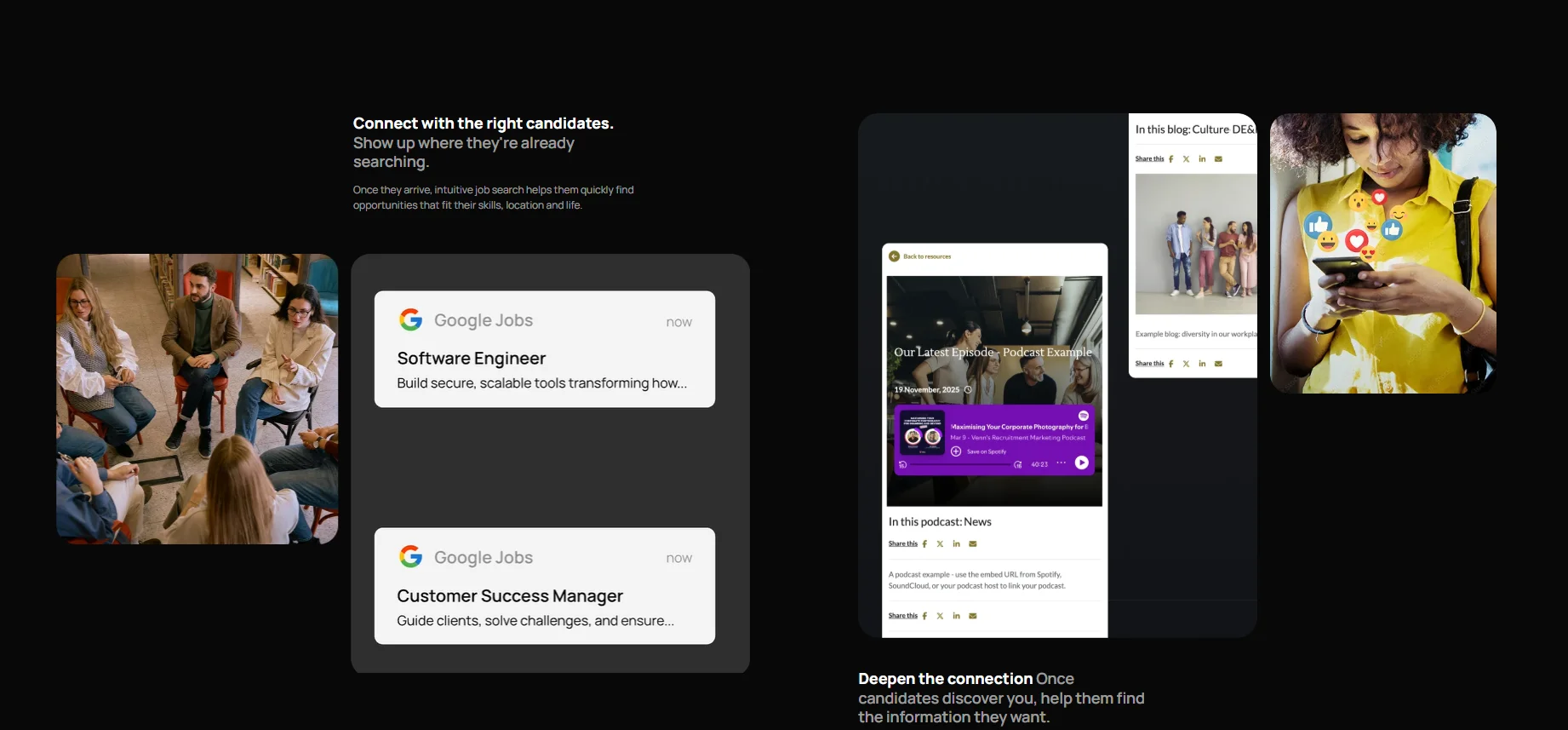
Search behaviour has evolved, with Google for Jobs and AI-driven results playing a much bigger role in discovery. At the same time, content expectations have shifted towards more visual, people-led formats. Candidates are used to building an understanding of a company through what they see, not just what they read.
A content-driven approach brings these elements together. It ensures your site is not only discoverable in search, but also engaging once candidates land on it.
How Candidates Discover and Explore Roles
Candidate journeys are no longer linear. They move between platforms, content and search before ever reaching an application.
In most cases, that journey includes:
- Searching for roles via Google or Google for Jobs
- Discovering content through LinkedIn or other social platforms
- Clicking through to a careers or recruitment site
- Exploring roles alongside content before deciding to apply
Each of these steps plays a role in shaping perception.
If your site is well-optimised for search but lacks engaging content, candidates will find it but not convert. If it has strong content but poor structure, it may not be discovered in the first place. Both sides need to work together.
Balancing SEO, Content and Design
A high-performing careers or recruitment site sits at the intersection of three things:
- SEO and structure – ensuring roles are indexed, visible and aligned to how candidates search
- Content – helping candidates understand what the company or client actually looks like
- Design and UX – making it easy to move through the journey without friction
At Venn, this is something we see consistently across client sites. Improvements rarely come from focusing on just one area. It’s the combination that drives performance.
From an SEO perspective, this includes clear job titles, structured job data, and content that aligns with search intent. From a design perspective, it’s about making content easy to access and navigate. From a content perspective, it’s about giving candidates enough context to make a decision.
The Content That Makes the Difference
Once candidates land on your site, content becomes the deciding factor.
The formats that consistently perform well include:
- Short-form video such as day-in-the-life clips, team introductions and project snapshots
- Employee-generated content pulled from platforms like LinkedIn, showing real perspectives from within the business
- Ongoing social content including updates, events, hiring activity and team moments
- Team-level insight that gives candidates visibility into how specific teams operate
These formats help move beyond static descriptions and give candidates a clearer understanding of what they’re applying for.
Designing User Journeys That Convert
One of the biggest differences between average and high-performing sites is how well the user journey has been thought through.
At Venn, we approach this from a performance and UX perspective. The goal is to make it as easy as possible for candidates to move from discovery to application without losing context.
In practice, that means:
- Making sure content is visible early, not hidden behind multiple clicks
- Allowing candidates to explore content alongside job listings
- Reducing friction between pages and keeping navigation simple
- Ensuring the experience works seamlessly across mobile and desktop
When these journeys are designed intentionally, candidates stay engaged for longer and are more likely to convert.
Careers Sites vs Recruitment Agency Sites
While the principles are the same, how they’re applied can differ slightly.
For in-house careers sites, the focus is on giving candidates a clear view of the organisation. This includes:
- Showcasing company culture and team dynamics
- Providing insight into different departments
- Building long-term brand perception through content
For recruitment agencies, the challenge is slightly different. It’s about representing multiple clients while still creating a consistent experience.
That often involves:
- Creating content that reflects different client environments
- Using role-specific or sector-specific content to add context
- Building trust with candidates who may not yet know the end employer
In both cases, content helps bridge the gap between a job listing and a real understanding of the opportunity.
How Venn Supports Content-Driven Sites
At Venn, we design careers and recruitment sites with performance, content and user journeys in mind.
Features like Social Hub bring together:
- Employee-generated content
- Social posts from across the business
- Video, blogs and other media formats
Alongside this, SEO optimisation, structured job feeds and smart search functionality ensure roles are discoverable in the first place.
Because everything sits within one platform, content, jobs and user journeys are connected. Candidates can move from discovering content to exploring roles without disruption.
The Takeaway
A content-driven careers or recruitment site isn’t just about adding more content.
It’s about making sure your site can be found in search, provides the right level of context, and is designed in a way that supports how candidates actually move through the journey.
When SEO, content and user experience are aligned, the result is a site that not only attracts traffic, but converts the right candidates.
Bring Your Careers Site Together
If you’re looking at how your careers or recruitment site is performing, it’s worth considering how SEO, content and user journeys work together.
At Venn, we help teams bring these elements into one platform, making it easier to create sites that are discoverable, engaging and built to convert.
Get in touch to see how it works in practice.